
Know before you go
Tanzania Travel Guide
Everything a first-time traveller asks us: where the parks are, when the migration moves, what to pack, visas, vaccinations, money and how much to tip. Written by our guides in Arusha.
Where to go
Interactive map of Tanzania's parks
Tap or hover a park to see details. Schematic map — not to survey accuracy.
Month by month
Great Migration calendar
January
Southern Serengeti / NdutuHerds spread across short-grass plains, first calves drop.
February
Ndutu & Ngorongoro conservation plainsPeak calving — around 8,000 calves a day and constant predator action.
March
Southern & central SerengetiCalves strengthen, herds begin drifting north-west as rains build.
April
Central Serengeti (Seronera)Long rains; columns form and move through the Moru kopjes.
May
Western CorridorRutting season, long marching columns, Grumeti River approach.
June
Grumeti RiverFirst river crossings; huge crocodiles wait in the Grumeti.
July
Northern SerengetiHerds push north; early Mara River crossings begin.
August
Kogatende / Mara RiverClassic dramatic Mara River crossings — the peak spectacle.
September
Northern Serengeti & Masai MaraHerds shuttle back and forth across the Mara River.
October
Northern Serengeti / LoboShort rains start, the return south begins.
November
Eastern & central SerengetiFast movement south through Lobo and Seronera.
December
Southern Serengeti / NdutuHerds settle back on the nutrient-rich short-grass plains.
The migration follows the rains, so timings shift by two to three weeks each year. We track herd positions weekly and will place your camp accordingly.
Timing
Best time to visit each park
| Park | Peak season | Also good | Best avoided |
|---|---|---|---|
| Serengeti | Jun–Oct | Jan–Mar (calving) | Apr–May (long rains) |
| Ngorongoro Crater | Jun–Oct | Great all year | Apr–May (mud, mist) |
| Tarangire | Jul–Oct | Jun | Mar–May |
| Lake Manyara | Jul–Oct | Nov–Jun for birding | Apr–May |
| Kilimanjaro | Jan–Mar, Jun–Oct | Dec (busy) | Apr–May, Nov |
| Mikumi | Jun–Oct | Jan–Feb | Mar–May |
| Nyerere / Selous | Jun–Oct | Jan–Feb | Mar–May (camps close) |
| Ruaha | Jun–Nov | Dec–Feb (birding) | Apr–May |
| Katavi | Aug–Oct | Jun–Jul | Mar–May |
| Mahale / Gombe | Jul–Oct | Dec–Feb | Apr–May |
| Zanzibar | Jun–Oct, Dec–Feb | Nov (short rains) | Apr–May |
Long dry season · Jun–Oct
Best game viewing everywhere — animals concentrate at water, grass is short, roads are firm. Busiest and priciest.
Short rains · Nov–Dec
Brief afternoon showers, green landscapes, migratory birds and fewer vehicles. Excellent value.
Long rains · Mar–May
Heaviest rain, some remote camps close and tracks turn to mud — but the lowest rates of the year.
What you'll see
Wildlife guide
The Big Five
Lion
SimbaSerengeti, Ruaha, Ngorongoro
Ruaha holds some of Africa's largest prides; Serengeti kopjes are prime daytime spotting.
Leopard
ChuiSeronera valley, Nyerere, Manyara
Look along sausage and acacia trees on riverbanks in early morning and late afternoon.
African Elephant
TemboTarangire, Ruaha, Serengeti
Tarangire in the dry season has one of the highest elephant densities on the continent.
Cape Buffalo
NyatiNgorongoro, Katavi, Mikumi
Old solitary bulls ('dagga boys') are the most dangerous animals to encounter on foot.
Black Rhino
FaruNgorongoro Crater, Moru kopjes
The Crater floor is Tanzania's most reliable black rhino sighting — bring binoculars.
Beyond the Big Five
Cheetah
Fastest land animal; best on the open southern Serengeti plains.
Wildebeest
Roughly 1.5 million animals drive the Great Migration.
Plains Zebra
Migrate with wildebeest — 200,000+ join the columns.
Giraffe
The Masai giraffe is Tanzania's national animal.
Hippopotamus
Retima pool (Serengeti) and the Rufiji River hold hundreds.
Nile Crocodile
Mara and Grumeti rivers — the crossing specialists.
African Wild Dog
Endangered; Nyerere and Ruaha are the strongholds.
Spotted Hyena
Highly successful hunter, not merely a scavenger.
Chimpanzee
Trek them at Mahale and Gombe on Lake Tanganyika.
Flamingo
Lakes Natron, Manyara and Magadi turn pink in season.
Greater Kudu
Spiral-horned antelope, a Ruaha speciality.
Colobus Monkey
Black-and-white in Arusha NP; red colobus in Jozani, Zanzibar.
Before you fly
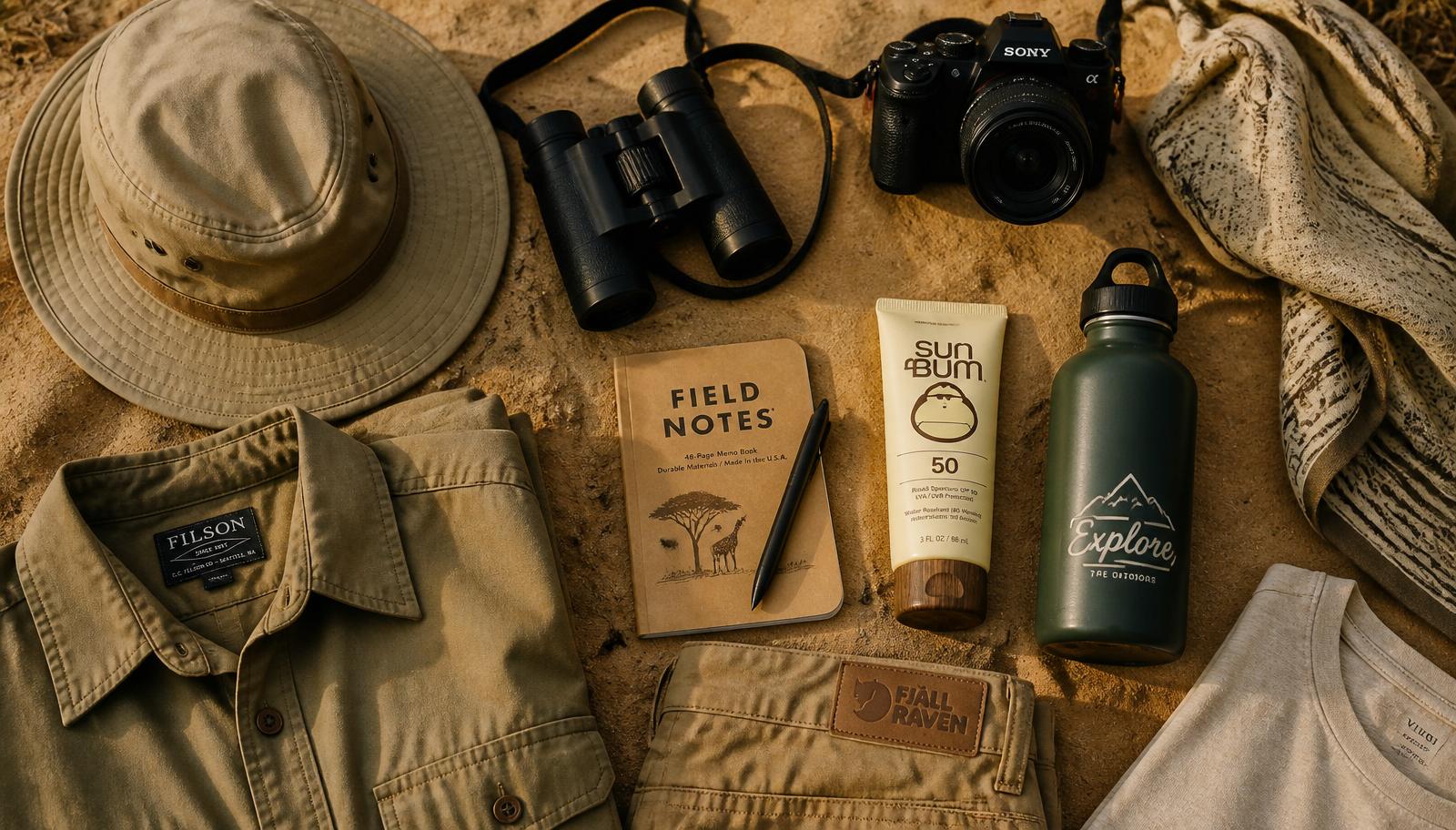
Packing checklist
Clothing
- Neutral colours: khaki, olive, beige, brown (avoid blue/black — tsetse flies)
- 3–4 short-sleeve shirts and 2 long-sleeve shirts (sun and mosquito cover)
- 2 pairs of safari trousers plus 1–2 pairs of shorts
- Fleece or warm jacket — Ngorongoro and Serengeti mornings drop near 10°C
- Wide-brimmed hat, sunglasses and a light scarf/buff for dust
- Swimwear for lodge pools and Zanzibar
- Modest cover-up for Stone Town and rural villages
Footwear & bags
- Comfortable closed walking shoes or light hiking boots
- Sandals or flip-flops for camp
- Soft-sided duffel (hard suitcases don't fit bush flights)
- Bush flights limit luggage to 15 kg per person including hand baggage
- Small daypack for the vehicle
Health & toiletries
- Malaria prophylaxis prescribed by your doctor
- Insect repellent with 30–50% DEET
- SPF 50 sunscreen and lip balm
- Personal medication in original packaging, plus a copy of prescriptions
- Basic kit: rehydration salts, antihistamine, plasters, painkillers
- Wet wipes and hand sanitiser
Gear & documents
- Binoculars (8x42 recommended) — one pair per person
- Camera with a zoom lens, spare batteries and memory cards
- Universal adapter — Tanzania uses UK-style Type G, 230V
- Power bank; many camps run generators only part of the day
- Headtorch for tented camps
- Passport valid 6+ months, visa/e-visa copy, yellow fever certificate if required, travel insurance details
- USD cash in notes issued 2009 or later for tips and visas
Entry
Visa information for Tanzania
Do I need a visa?
Most nationalities do. Apply online in advance at the official Tanzania Immigration e-visa portal (visa.immigration.go.tz) — allow at least 10 working days. Visas on arrival are also issued at Kilimanjaro (JRO), Julius Nyerere (DAR) and Zanzibar (ZNZ) airports for many passports, but queues can be long.
How much does it cost?
Ordinary single-entry tourist visa: USD 50. US passport holders must take the multiple-entry visa at USD 100. Transit visa USD 30. Fees are paid in cash USD or by card on the e-visa portal.
How long is it valid?
A tourist visa allows stays of up to 90 days. The single-entry visa is generally valid for 3 months from issue; the US multiple-entry visa for 12 months.
Passport requirements
Passport must be valid for at least 6 months beyond arrival with at least one blank page. Bring a printed copy of your e-visa approval and your return ticket.
Zanzibar
Zanzibar is part of Tanzania — no separate visa. However, mandatory Zanzibar travel insurance (about USD 44 for up to 92 days) must be purchased online before arrival at the ZIC portal, and an infrastructure levy of about USD 5 per night is payable at your hotel.
Requirements and fees change — always confirm with the official Tanzania Immigration portal or your nearest Tanzanian mission before travelling. We are happy to send a supporting invitation letter.
Stay well
Health and vaccination guidance
Yellow fever
Not required if you arrive directly from Europe, North America or Asia. A certificate IS required if you arrive from — or transit more than 12 hours in — a yellow fever risk country (including Kenya, Uganda, Ethiopia and much of West/Central Africa). Carry the yellow card if in any doubt.
Malaria
Present in almost all safari areas below 1,800 m, including Nyerere, Ruaha, Mikumi, Zanzibar and the coast. Take prophylaxis (Malarone, doxycycline or mefloquine) exactly as prescribed, use repellent at dawn and dusk, wear long sleeves in the evening and sleep under the net provided. Ngorongoro rim and Kilimanjaro's upper slopes are low risk.
Routine vaccinations
Ensure MMR, DTP (tetanus/diphtheria/polio), and chickenpox are up to date. Hepatitis A and typhoid are recommended for nearly all travellers; hepatitis B, rabies and meningitis for longer stays, rural travel or animal contact. Consult a travel clinic 6–8 weeks before departure.
Food & water
Drink bottled or filtered water only — safe drinking water is provided in every vehicle and camp. Avoid ice from unknown sources, raw salads at street stalls and unpeeled fruit. Lodge and camp kitchens on our itineraries are safe.
Altitude (Kilimanjaro)
Above 3,000 m headache, nausea and breathlessness are common. Walk pole pole (slowly), drink 3–4 litres a day, and consider Diamox after speaking with your doctor. Our guides carry pulse oximeters and emergency oxygen and check you twice daily.
Insurance & evacuation
Comprehensive travel insurance including medical evacuation is mandatory on all our trips, and must cover trekking above 4,000 m for Kilimanjaro climbs. Flying Doctors (AMREF) cover can be arranged for a small fee.
This is general guidance, not medical advice. Speak to a travel health professional at least six weeks before departure.
Money
Currency and live exchange rates
Paying in Tanzania
Park fees, lodges and safaris are quoted in USD. Bring clean USD notes issued 2009 or later — older or torn notes are refused, and notes of USD 50/100 get a better rate than small bills. Tanzanian shillings are best for markets, tips to local vendors, snacks and taxis.
Cards & ATMs
ATMs in Arusha, Moshi, Dar es Salaam and Zanzibar dispense shillings (usually TZS 400,000 per withdrawal). Visa is accepted more widely than Mastercard; Amex rarely. Lodges that take cards often add 3–5%. There are no ATMs inside the national parks — carry cash for tips.
Gratuities
Tipping guide
| Who | Suggested | Notes |
|---|---|---|
| Safari driver-guide | USD 20–30 per vehicle, per day | Split between the group, handed over at the end of the safari. |
| Camp / lodge staff (communal box) | USD 10–15 per guest, per day | Shared among kitchen, housekeeping and waiting staff. |
| Butler or dedicated waiter | USD 5–10 per day | Only where a personal service is provided. |
| Kilimanjaro lead guide | USD 20–25 per day | Given at the tipping ceremony on the last morning. |
| Kilimanjaro assistant guide | USD 12–15 per day | One assistant per 2–3 climbers is standard. |
| Kilimanjaro cook | USD 10–15 per day | Per cook, split by the group. |
| Kilimanjaro porter | USD 8–10 per day | Per porter — a typical group has 3 porters per climber. |
| Balloon pilot / activity guide | USD 10–20 per person | Discretionary, for exceptional service. |
| Restaurant & bar | 5–10% of the bill | Only where service is not already included. |
| Porter at airport/hotel | USD 1–2 per bag | Small notes are useful here. |
Tipping is customary but never obligatory. Bring small USD notes (1, 5, 10, 20) or shillings — an envelope handed over personally at the end of the trip is the local norm.